What Is SEO? How Search Works and Where to Start
Learn what SEO is, how search engines work, and which changes help your website. Compare SEO with paid ads and follow clear steps to measure real results.
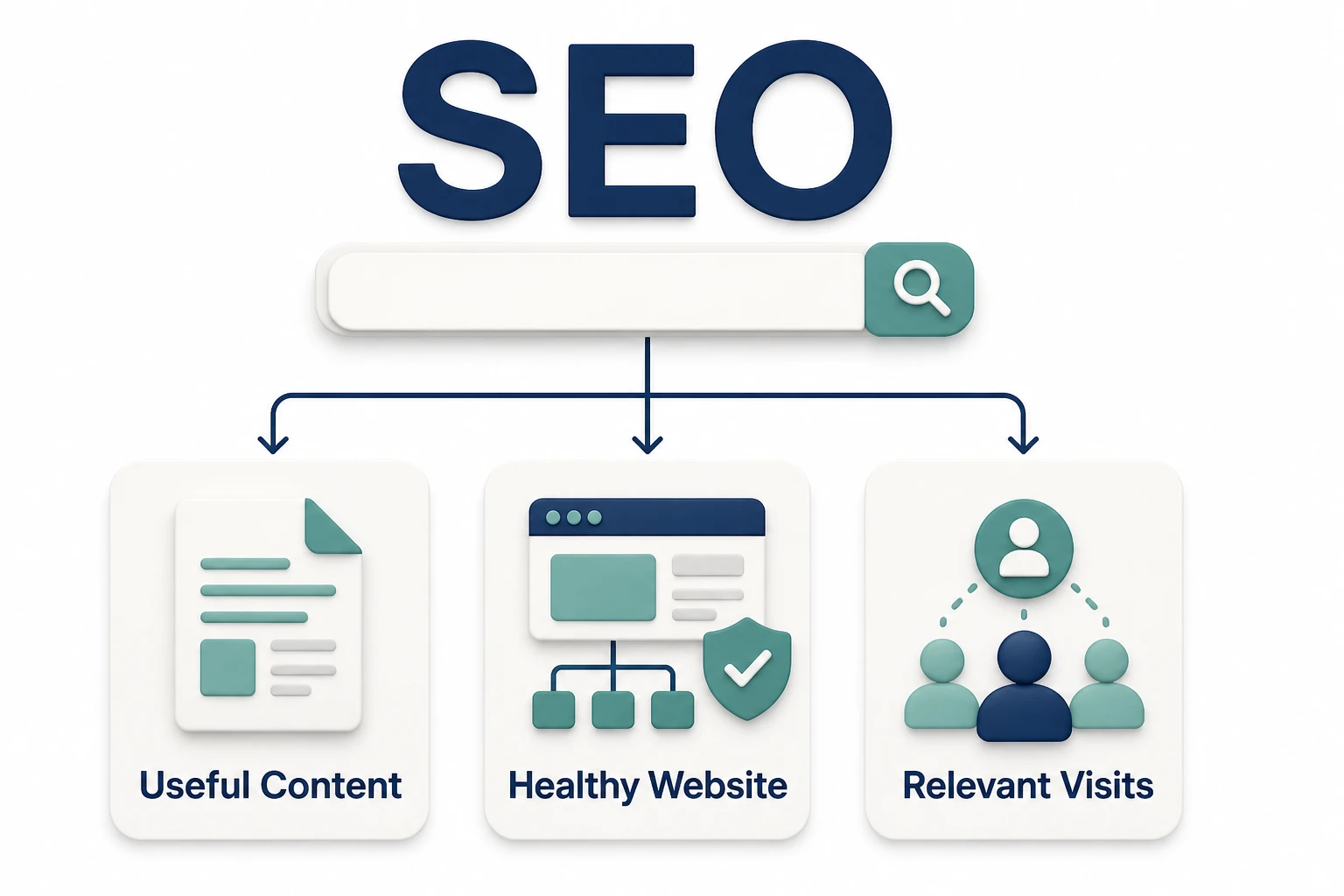
SEO, or search engine optimization, is the work of improving a website so search engines can find it, understand it, and show it to people searching for relevant topics. It helps a site earn visits from unpaid search results through useful content, a well-built website, and signs of trust. SEO does not buy rankings or guarantee first place. Its real value comes from attracting people who may become customers or readers.
What Does SEO Actually Do for a Website?
SEO helps your website appear when people search for something your business or content can help with. The goal is not simply more traffic, but more visits from people whose needs match what you offer.
For example, a plumbing company might want to appear for "emergency plumber in Manama", while a home repair blog might target "why does my tap keep dripping". Both use SEO, but the searches call for different pages. The first needs a clear service page with contact details and coverage areas, while the second needs a useful explanation.
That difference matters because search intent, which means the reason behind a search, shapes what should appear on the page. A person who wants to hire someone should not have to read a long history of plumbing before finding a phone number.
Searches often fall into four broad groups.
| Search Intent | Example Search | Page That Usually Fits |
|---|---|---|
| Learn something | What is SEO | A clear explanation with examples |
| Find a known website | Digital Natix | The business website or a relevant brand page |
| Compare choices | SEO agency vs freelancer | A fair comparison of costs, scope, and trade-offs |
| Take action | Book an SEO audit | A service page explaining the offer and next step |
These groups can overlap, so check the actual results before choosing a page format. If most results are product listings, a general blog post may not give shoppers what they want.
Digital Natix covers SEO alongside advertising, website work, and AI automation. These services have different roles: SEO helps people discover a site, while a clear website helps those visitors take the next step. Getting a confusing page to rank does not make it easier to use.
How Do Search Engines Find and Rank Pages?
Search engines discover pages, store information about them, and choose which results best answer a search. These stages are called crawling, indexing, and ranking. A problem at one stage needs a different fix from a problem at another.
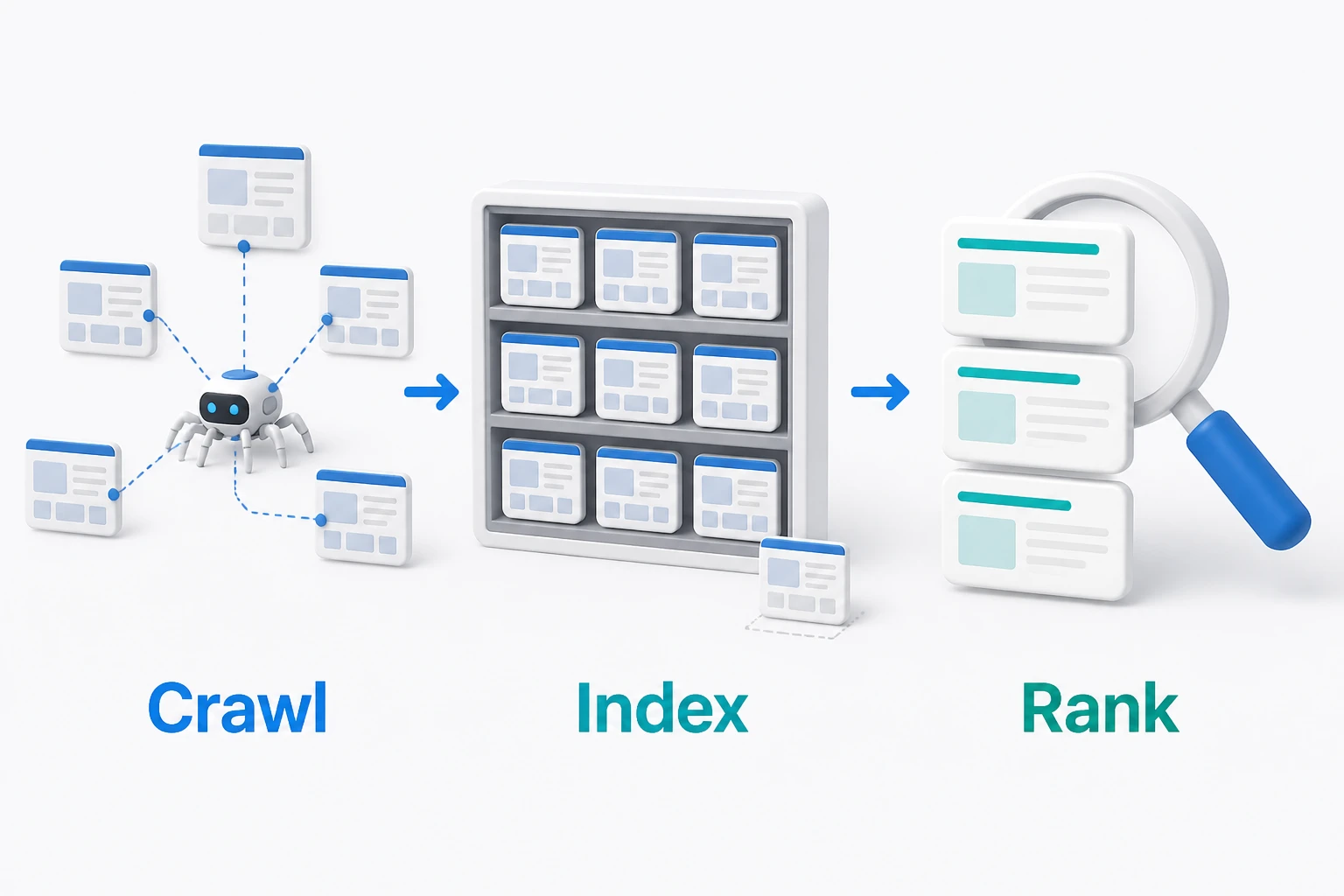
- Crawling: Search engines use automated programs, often called crawlers or bots, to find pages through links and other methods. A sitemap, which lists important website URLs, can help them discover pages.
- Indexing: The search engine reviews a page and may store it in its index, the collection of pages it can use for search results. Finding a page does not guarantee that the search engine will index it.
- Ranking: For each search, the engine selects results using many signals, including relevance, content quality, links, and parts of the page experience.
An indexed page can appear in search results, but it is not promised a high position. Submitting a sitemap does not mean Google must rank your site either.
To find out why a page is missing from search results, first check whether Google knows about it before rewriting its content. Google Search Console, a free tool for website owners, includes URL Inspection to check a page's indexing status.
If a page is blocked from indexing, adding more keywords will not solve the problem. If the page is indexed but answers the wrong question, fixing server settings will not solve that problem either.
Search results also change by location, language, device, and the search itself. Two people may see different results, so one manual search is not a reliable measure of overall performance.
What Are the Main Types of SEO?
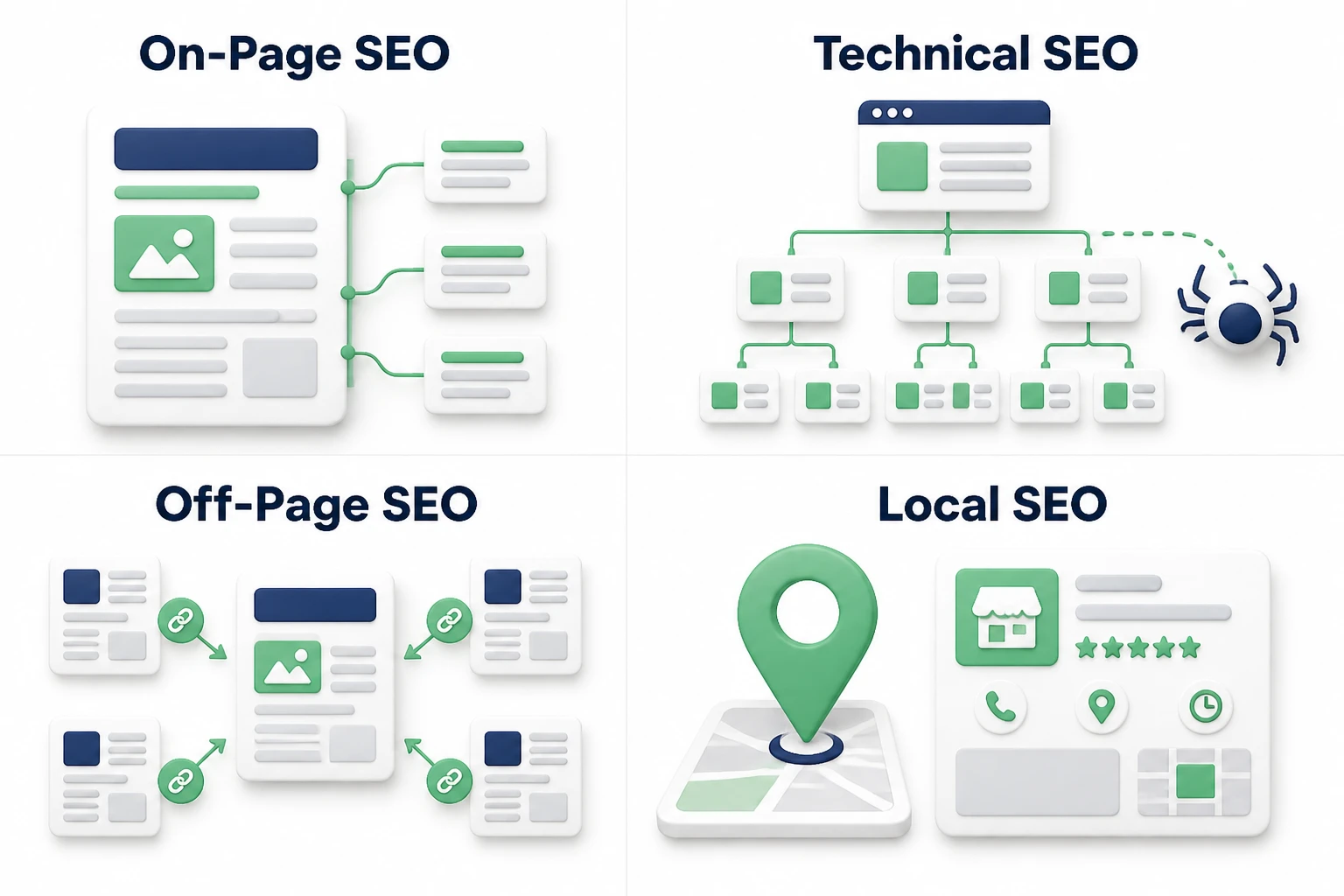
The main areas of SEO are on-page SEO, technical SEO, off-page SEO, and local SEO. They work together, but the right starting point depends on what is stopping your pages from being found or chosen.
On-Page SEO Makes Each Page Useful and Clear
On-page SEO improves the content and elements of an individual page. It includes the page title, headings, written content, internal links, and image descriptions.
A keyword is a word or phrase people use in search. Keyword research helps you learn the language your audience uses, but the work should lead to a useful page rather than a pile of repeated phrases.
For example, a page about boiler repairs should explain which repairs the company handles, where it works, and how to arrange a visit. Repeating "boiler repair" in every paragraph does not fill in those missing details.
A title tag helps describe a page in browser tabs and search results, although Google may show a different title. A meta description is a short summary that Google may use beneath the title. Meta descriptions are not a direct Google ranking factor, but a clear summary can help people decide whether a result fits their needs.
Internal links connect pages on the same site and help readers and search engines find related material. Use descriptive link text rather than "click here", and link where the next page genuinely helps.
Technical SEO Removes Barriers to Access
Technical SEO helps search engines access and understand your website while keeping it usable for visitors. Common tasks include fixing broken pages, improving mobile use, checking indexing settings, and making important content load reliably.
A canonical tag suggests the preferred version when similar pages exist at more than one URL. A redirect sends visitors and search engines from an old address to a new one. These tools solve different problems, so they should not be used as interchangeable fixes.
One common launch error is leaving a noindex setting enabled when a new website goes live. Noindex tells search engines not to include a page in their results, which can hide otherwise useful content.
Google's Core Web Vitals measure loading speed, response to user actions, and visual stability. They are worth improving, but a fast page with a weak answer does not automatically rank higher than a useful page.
Off-Page SEO Builds Credible Connections
Off-page SEO deals with signals from outside your website, especially links from other sites. A backlink is a link from another website to yours, and relevant editorial links can help search engines discover and assess your pages.
Not all links have equal value. A genuine reference from a relevant publication is different from hundreds of unrelated links bought as a package.
Google's spam policies restrict links created mainly to manipulate rankings. Buying such links can lead to ignored links or a penalty, so a low price per link is not a useful measure of value.
Create material people have a reason to cite, such as a helpful tool, a clear technical explanation, or original research that you actually carried out. Do not invent research simply to make a page look authoritative.
Local SEO Connects Businesses with Nearby Customers
Local SEO helps eligible businesses appear for searches tied to a place, including map results. It involves website content, accurate business details, reviews, and a properly managed Google Business Profile, which is Google's business listing service.
Distance matters in local results, so a business cannot promise to rank first across an entire country from one location. A business that travels to customers also should not create fake office addresses to make its service area seem larger.
Businesses considering SEO services in Manama, SEO services in Muharraq, or local SEO in Riffa need pages that explain their real services and coverage. Replacing the city name on otherwise identical pages adds little value unless each page answers a genuine local need.
For businesses serving several languages, the same principle applies to content. SEO in Montreal may involve English and French pages, but language choices should reflect the audience's needs rather than an assumption that every page needs a translation.
How Is SEO Different from Paid Search?
SEO earns visibility in unpaid search results, while paid search buys advertising placements through an ad platform. Paid ads can help you reach an audience faster, but SEO can keep attracting visits without a charge for each organic click.
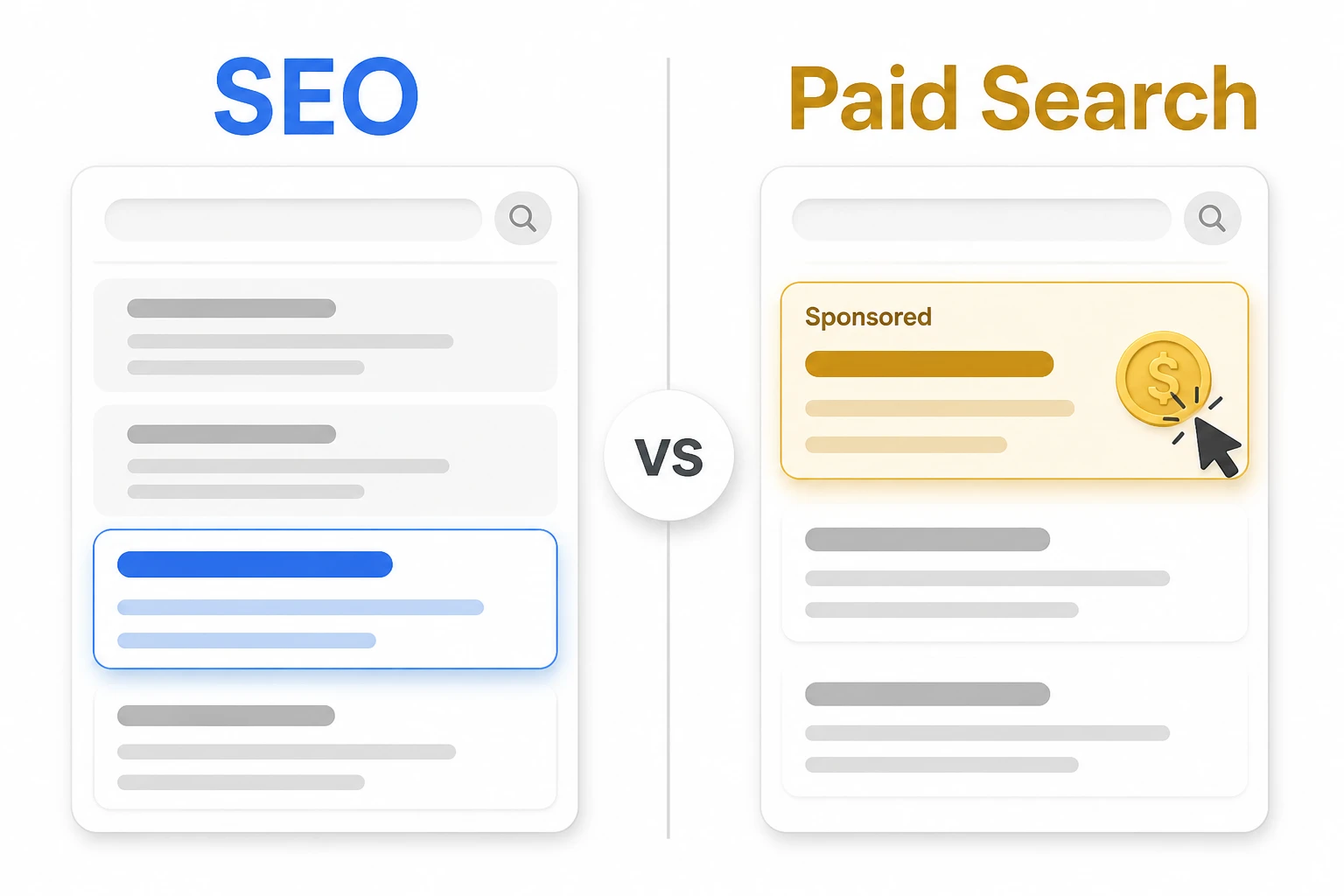
| Question | SEO | Paid Search |
|---|---|---|
| Do you pay for each click? | Not to the search engine for organic clicks | Usually, under a pay-per-click model |
| How quickly can visits start? | Depends on discovery, competition, and the site's condition | Can start once ads are approved and running |
| What work is involved? | Content, website improvements, links, and ongoing checks | Campaign setup, budgets, targeting, ads, and landing pages |
| What happens when spending stops? | Useful pages may continue to attract visits, but positions can change | Ad traffic generally stops when campaigns stop |
| Where does it fit best? | Building lasting visibility for relevant topics and services | Testing offers, reaching time-sensitive demand, and supporting launches |
SEO is not free, even when clicks are unpaid. Someone must research, write, build, fix, and maintain the site, and that work takes time or money.
The better choice depends on the task. If a business needs enquiries for an event next week, ads may be a better first move than a new SEO campaign. If customers search for the same service throughout the year, useful search pages can be a worthwhile ongoing investment.
A broader digital marketing plan in Bahrain or digital marketing plan in Canada can combine both channels. Keep their results separate when measuring them, because sales or enquiries from paid ads do not prove that organic search has improved.
How Do You Start SEO on a Website?
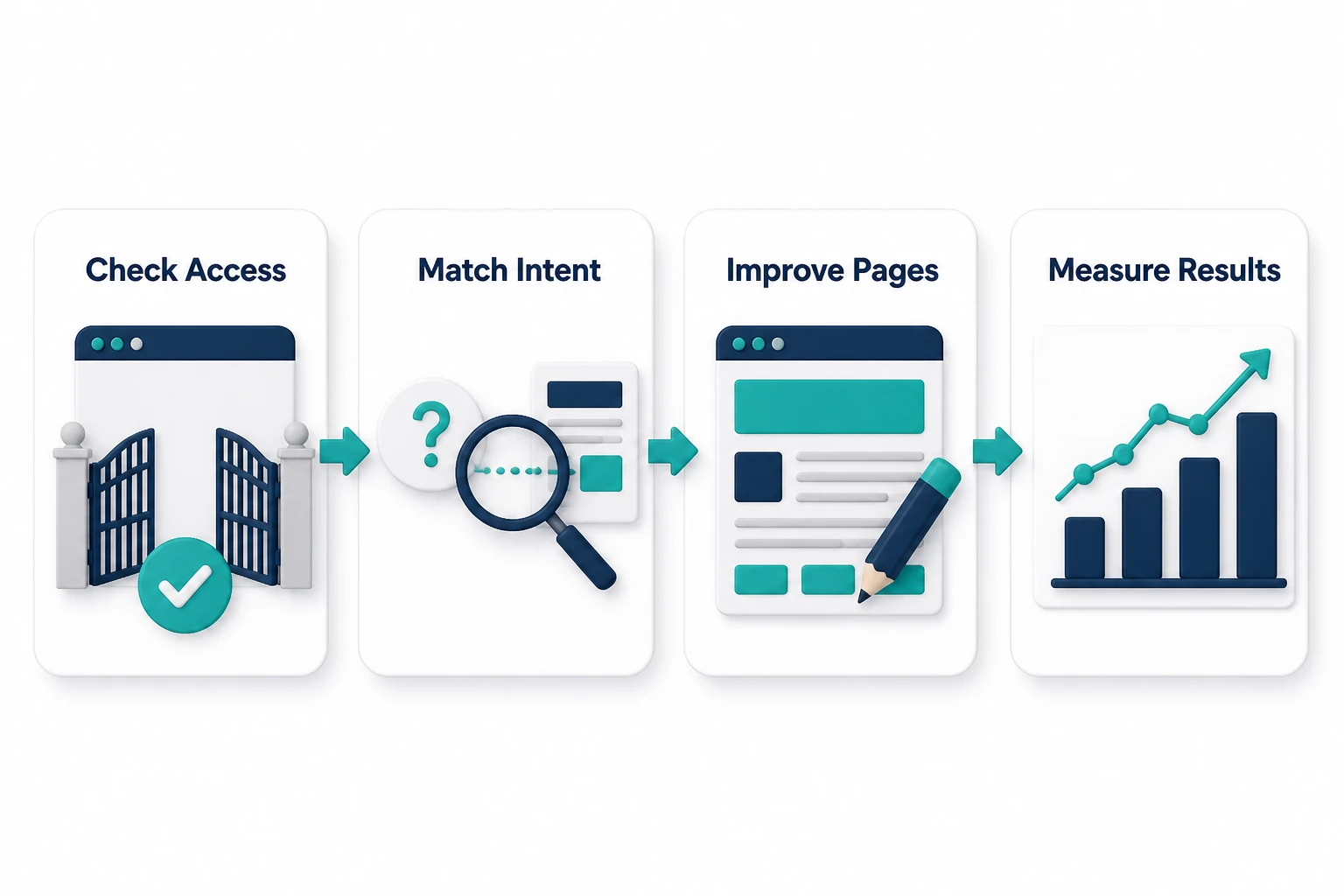
Start SEO by checking whether your important pages can be indexed, then improve the pages that serve real customer needs. Fix access problems before publishing more content, and focus on a manageable set of pages rather than changing the whole site at once.
- Set a useful goal. Choose an outcome such as more qualified enquiries, product sales, or visits to a support page. "Rank for more keywords" is too vague to guide the work.
- Set up basic measurement. Verify the site in Google Search Console and use a suitable analytics tool to track visits and key actions. Follow the privacy and consent rules that apply to your visitors.
- Check important pages. Confirm that service pages and other key URLs work, are not blocked from indexing, and can be reached through website links.
- Choose a search need. List the questions customers ask and check the results for those searches. Pick topics that connect to your actual services or knowledge.
- Improve the best matching page. Give it a clear title, a direct opening answer, useful detail, and an obvious next step. Update an existing relevant page before creating another page with the same purpose.
- Connect related pages. Link supporting articles to the relevant service or product page, and make key pages easy to reach from the main navigation.
- Review and adjust. Check whether the page is appearing for suitable searches and whether visitors take useful actions. Keep a record of changes so you can understand the results.
For example, consider a company offering SEO in Calgary. Its service page should explain the work offered, the audience it serves, and how to request help. A separate article could explain how local search works, then link to that service page where the connection is useful.
Creating ten articles before checking a broken contact form would be the wrong order. Search traffic cannot produce enquiries through a form that fails.
A business with a wider service area may need a broader approach, such as SEO across Bahrain or SEO across Canada. Use location pages only when you can explain a real difference in service, coverage, language, or customer needs.
What Should You Avoid When Starting?
Avoid keyword stuffing, copied pages, purchased ranking links, and claims that a provider has special access to Google's organic rankings. Google does not sell a higher organic position, and no provider can guarantee one.
Another common mistake is deleting useful detail just to make a page shorter. Keep details that help the reader choose or act, but remove repetition and unrelated background. There is no ideal SEO word count.
AI tools can help with planning and editing, but someone still needs to check the facts and add the knowledge the reader needs. Publishing large amounts of content with little useful information mainly to influence rankings can violate Google's spam policies, regardless of how that content was made.
How Do You Know Whether SEO Is Working?
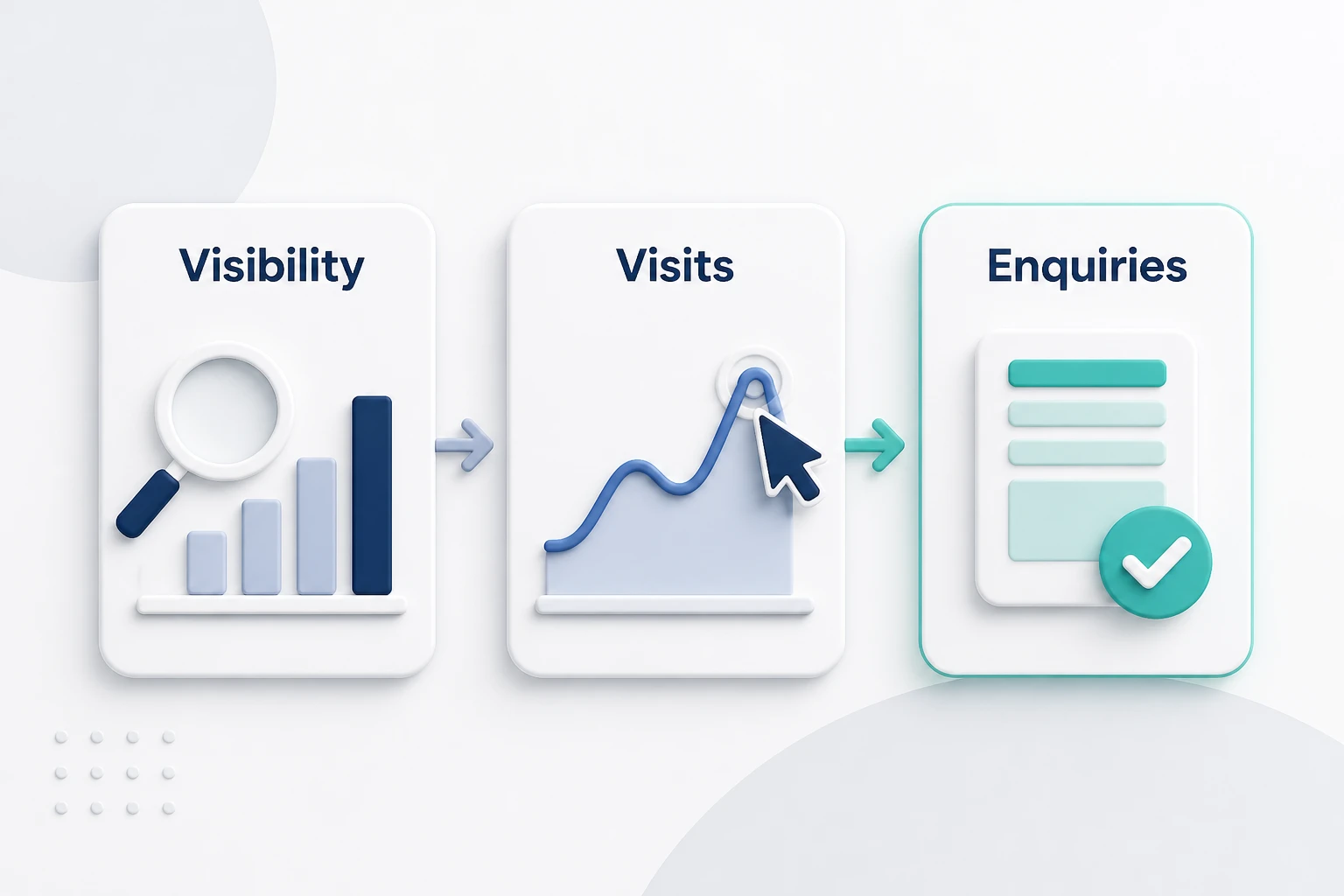
SEO is working when your site becomes more visible for relevant searches and those visits produce useful outcomes. Rankings and traffic help explain progress, but they should not replace enquiries, sales, or other goals that matter to the website.
| Measure | What It Tells You | What to Watch For |
|---|---|---|
| Search impressions | How often your site appears in search results | More appearances for unrelated searches may have little value |
| Organic clicks | Visits from unpaid search results | Separate these from advertising clicks |
| Click-through rate | The share of impressions that lead to clicks | Results layout and position can affect it, not just the title |
| Relevant enquiries or sales | Whether visits support business goals | Check lead quality, not only the number of form submissions |
| Indexed pages | Whether important pages are eligible to appear | More indexed pages is not always better |
Suppose a page appears in search results 2,000 times and earns 100 clicks. Its click-through rate is 5 percent, calculated as 100 divided by 2,000, then multiplied by 100. This is a worked example, not a target for every page, because useful rates differ by search query and results layout.
Compare similar periods and account for seasonal demand. A holiday business may gain traffic because its busy season started, not because every recent SEO change worked.
Separate branded searches, which include your business name, from searches by people who do not yet know you. A rise in brand searches after an advertising campaign can make organic traffic look stronger without showing better visibility for broader topics.
Does Appearing in an AI Overview Count as SEO Success?
Appearing in an AI Overview can help more people see your content, but it does not guarantee website visits or sales. Google says its established SEO practices also apply to its AI search features, and there is no special markup that guarantees inclusion.
Clear answers, accessible pages, accurate facts, and helpful supporting detail make content useful to readers and easier for systems to understand. They do not guarantee that an AI answer will cite your page.
Structured data is code that labels information on a page for search engines. It can support eligible search features, but it is not a general ranking boost or a guaranteed route into an AI answer.
Track business outcomes alongside visibility, because a quoted answer that produces no visits has a different value from a service page that brings suitable enquiries.
Should You Do SEO Yourself or Hire Help?
You can handle basic SEO yourself when the website is small and you have time to learn, write, and review results. Professional help becomes more useful when technical issues, multiple markets, or the amount of work exceed your time or skills.
A small business can begin with accurate service information, clear page titles, working contact options, and a verified business profile where eligible. A large online shop with many product URLs may need technical help before a content plan can make much difference.
Ask a provider to explain what they will change, why it matters, and how they will measure it. Useful proposals clearly separate website fixes, content work, local listing work, and advertising, rather than treating them as one unexplained package.
Choose the work you need before choosing the supplier. Businesses needing website and advertising work as well as SEO may consider a digital marketing agency in Manama, a digital marketing agency in Muharraq, or a digital marketing agency in Riffa. The question is whether the provider can fix the website problems that stop visitors from becoming customers, not simply report more keywords.
The same applies when assessing a digital marketing agency in Calgary, a bilingual marketing agency in Montreal, or a digital marketing agency in Toronto. Location can help with market knowledge and communication, but it is not proof of search expertise.
Before agreeing to work together, confirm that you retain control of your domain, website, Search Console, analytics, and business listings. Request a clear account of completed work and avoid deals built around guaranteed positions.
Start with one small, specific task: choose an important page, confirm that search engines can access it, and make it answer the visitor's need more clearly. Measure what changes before expanding the work.
Frequently Asked Questions
How Long Does SEO Take to Show Results?
SEO can show some changes within weeks, but meaningful progress often takes months and is not guaranteed. The timing depends on the site's condition, competition, and the changes made. An indexing fix may take effect sooner than building visibility for a competitive service, so judge progress against the actual work rather than a fixed deadline.
Can a New Website Rank Without Backlinks?
A new website can rank without backlinks, especially for specific searches with limited competition. Clear content and accessible pages still matter, but competitive topics may be harder without relevant links and other signs of trust. Start with needs you can answer well rather than assuming that buying links is a required first step.
Is SEO Only for Google?
SEO is not only for Google, because other search engines also discover, index, and rank web pages. Many basics, such as useful content and clear website links, apply across engines. Search inside platforms such as YouTube has its own systems, so the best approach also depends on where your audience looks for answers.
Will Changing My Website Design Hurt SEO?
A website redesign can hurt SEO if it removes useful content, breaks links, or changes URLs without suitable redirects. A visual update alone does not have to cause a loss. Before launch, record important pages and check that their content, indexing settings, internal links, and tracking still work on the new site.
Do Social Media Posts Directly Improve Google Rankings?
Social media likes and follower counts are not direct Google ranking factors. Social posts can still help people discover your content, and some of those people may visit, share, or link to it. Treat social media as a way to reach an audience rather than a shortcut that guarantees higher organic search positions.
Want us to look at your situation?
Share your website and goals. We will reply with honest, specific suggestions.